Town Meeting Ambush
Town Meeting members were ambushed in June by last minute articles requesting approval for significant “one-time” funds. While there were other questionable appropriations; for example, $65,000 to acquire a private sewer line from a party which owes the town permitting fees and reimbursement for repairs, this email focuses on the two largest appropriations. These were:
$1.3 million for temporary and permanent easements for the Community Path. This may include takings of private property by eminent domain.
$500,000 in bonus payments to Education Department staff.
The process of advancing these requests to Town Meeting was deeply flawed and the amounts requested are certain to have a financial impact. Whether you agree or not with Town Meeting’s approval of these appropriations, the way these were pushed forward is reckless and was devoid of any examination of alternatives, opportunity costs, fiscal impact and risk.
Community Path Easements: A Last-Minute Cost Increase
Town Meeting members were notified just two hours before the June 10 meeting that the estimated cost of easements for Community Path Phase 1 had increased five-fold, from $200,000 to $1.3 million.
That estimate had not yet been reviewed by town officials or any committee. Select Board Chair Matt Taylor stated that the $1.3 million figure came from an appraisal that had not yet been delivered to town officials. In effect, Town Meeting was asked to approve the appropriation without the benefit of the appraisal, a second appraisal review, or the usual due diligence.
Despite the lack of review, the vote was advanced on the grounds that negotiations with homeowners and businesses needed to be completed by the end of July for submission to the state in August. Chair Taylor also acknowledged that missing that timeline did not necessarily mean the town would lose state funding, even though residents were told the deadline was necessary to avoid “losing the Community Path.”
Several significant issues remained unresolved:
The payments may involve taking private property by eminent domain.
The $1.3 million estimate does not include potential legal fees if a homeowner or business challenges an easement.
Town Meeting was not given adequate time to assess alternatives, risks, or the fiscal impact before voting.
The town did not examine or confirm with the state what consequences, if any, would result from missing the August timeline.
Transparency and Due Diligence: In the absence of a thorough review, the more responsible course would have been to delay the vote until the new estimate could be properly vetted. Town Meeting should have had the opportunity to understand the trade-offs and risks of using these funds for the Community Path rather than other town needs, and to follow basic fiscal due-diligence practices before approving the appropriation.
The same process concerns apply to the $500,000 in educator staff bonuses funded by Free Cash.
Educator Bonuses: Transparency and Timing: The $500,000 for education staff bonuses was agreed to and publicly committed by town officials and school administration before review by the Warrant Committee or Town Meeting. Although the school department mentioned contract settlement payments at a Financial Summit, neither the amount nor the funding source was discussed before the bonuses were announced.
As a result, the legislative branch of town government had no meaningful opportunity to analyze the proposal before the commitment was made. Town Meeting was then asked to approve the use of public funds after the decision had effectively moved forward.
Free Cash for Compensation:
Using Free Cash for compensation sets a troubling precedent for future contract negotiations with all town unions, especially the Belmont Education Association (BEA).
The Education Department’s $74 million operating budget accounts for 67% of Belmont’s budget, not including debt service. The school district also maintains separate reserve funds.
Before asking Town Meeting to approve use of Free Cash, town and school officials should have explained why compensation-related payments could not be funded through the school budget or school reserves.
Impact of the raid on Belmont’s reserves:
Urgency Claims and Missing Fiscal Analysis: Town officials framed immediate approval as necessary to avoid dire consequences. The Community Path could be jeopardized; the tunnel could be eliminated, or the project could be sent “back to the drawing board.” Those claims created pressure for an immediate “yes” vote without giving Town Meeting members enough time to evaluate the underlying assumptions, alternatives, or risks.
The so-called “free” Community Path has now required $4.8 million from Belmont taxpayers, according to figures cited by town officials during Town Meeting. Before approving additional reserve funds, Town Meeting should have been shown whether this was the best use of Belmont’s constrained financial resources and why no fiscal impact analysis had been completed.
Use of Free Cash for Compensation: Proponents of the $500,000 outlay described the bonus payments as a legitimate “one-time use of one-time funds.” However, the payments reward regular staff duties, raising questions about whether Free Cash is the appropriate funding source.
The amount and funding source were not reviewed by the Warrant Committee before town officials publicly committed to the payment. As a result, the proposal effectively became a “done deal” before the Warrant Committee or Town Meeting had a meaningful opportunity to evaluate it.
Fiscal Review Before Compensation Commitments: This is not an argument against fair compensation for Belmont’s educators. It is an argument for fiscal analysis before committing town funds. Town Meeting members can strongly support educators while still requiring a clear explanation of available funding sources, the fiscal impact, and whether some or all of the $500,000 could have been paid through the school budget or school reserves.
Free Cash Is Not “Free”: Free Cash functions as Belmont’s savings account, helping stabilize spending and address unforeseen expenses, such as the unprecedented increase in insurance claims in 2026. The investment income used to fund the easement payments could instead have strengthened Belmont’s reserves by flowing into Free Cash or other reserve funds, helping the town better manage future financial uncertainty.
Risks of Drawing Down Reserves: The significant drawdown of Belmont’s reserves has created financial risk. Possible consequences include:
An override needed sooner than the current 2028 model anticipates;
A larger override in 2028 or earlier;
A greater need for debt exclusions to fund the $51 million in capital projects planned between now and 2031, with additional costs still unknown for the new DPW project planned for the 2030s;
Deferred maintenance on town buildings, resulting in higher eventual repair costs.
Unacceptable Financial Risk: This table, excerpted from the FY2027 Warrant Report, shows Belmont dead last in reserves when compared to peer towns. The report notes, (bolded for emphasis by the Warrant Committee), “However, this comparison highlights a long-term concern that our reserves, a key source for our ability to respond to unforeseen budget difficulties (such as a national economic downturn), should be higher than they are currently.
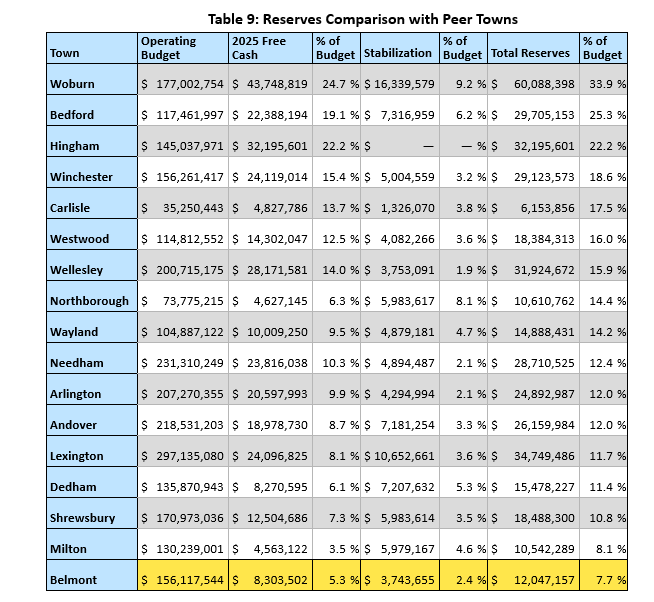
Source: 2027 Fiscal Year Warrant Commitee Report
Opportunity Cost: Also not considered before approving $1.3 million for easements and the $500,000 in bonus payments were alternative projects where those funds might be used to benefit the town – for example, repair of our sidewalks and roadways or paying down unfunded pension liabilities.
Noteworthy in this extravagant draw-down of the town’s reserves is that no funds at all were allocated to the Override Mitigation Fund. (OMF). The OMF is a buffer to stretch out the years until an override is warranted. There were no new funds added to the OMF, and in fact, the OMF will be tapped in 2027 to fund operations.
Takeaways:
The central issue is not only whether Town Meeting members supported or opposed these appropriations. The larger concern is the process: major financial commitments were advanced without adequate review, analysis, or transparency.
Town Meeting should insist on a fuller examination before voting on articles with significant fiscal consequences, including:
The alternatives that were considered;
The opportunity costs of using reserve funds for these purposes;
The impact on Belmont’s long-term financial stability; and
The risks to taxpayers if reserves are drawn down further.
Residents should encourage their precinct representatives to demand this level of review before approving major spending decisions. Whether voting “yes” or “no,” Town Meeting members should have the information needed to make a responsible decision.